Embedded Files
This type of “mask” can be called “the Dependent”, or also “the Hyperindependent”, because this person often tries to overcome dependency by helping other people. It corresponds to Type 2 in the Enneagram (a model that describes nine personality types).

A Polyvagal Interpretation of Type 2 of the Enneagram
A Polyvagal Interpretation of Type 2 of the Enneagram
From the perspective of Polyvagal Theory, the experiences and behaviors of a Type 2, especially when this person feels unworthy or devalued, can be understood as responses of the autonomic nervous system, the part of the nervous system that works without conscious control. Two branches are involved: the sympathetic system, which mobilizes the body, and the parasympathetic system, in particular its ventral vagal branch, which supports calm and social contact.
False Core Belief and Sympathetic Activation
False Core Belief and Sympathetic Activation
For a Type 2, the deep belief “I am worthless” or “I have no value” is a serious threat to the sense of safety and belonging, and it activates the sympathetic nervous system. This system produces the “fight or flight” response: heart rate, breathing and muscle tone rise to prepare the body to face or escape a threat. In polyvagal terms, this state is defined by heightened sympathetic activity, which prepares the person to act against the perceived threat to their worth.
When a Type 2 feels in a “zone of not safety”, marked by this sense of worthlessness, the nervous system may respond with a strong sympathetic surge. It shows in behaviors aimed at proving one’s worth to others: over-giving, seeking validation through achievements, or making others dependent in order to confirm one’s own value.
Parasympathetic Activation and Overcompensation
Parasympathetic Activation and Overcompensation
To soften these intense sympathetic responses and the distress that comes with them, a Type 2 may then adopt behaviors that stimulate the parasympathetic nervous system, in particular the ventral vagal complex, which is linked to social engagement and to feelings of safety and connection. This can take the form of “over-giving” or of excessive praise for others, used to create connection and belonging and so to counter the deep feeling of worthlessness.
This parasympathetic engagement, which seeks safety and worth through social bonds, rests on a false premise: the person’s own worthlessness. So these behaviors may bring temporary relief and a sense of value through connection, while the underlying false belief stays intact.
Reinforcement of the False Core Driver
Reinforcement of the False Core Driver
The cycle of sympathetic activation (fight or flight) in response to feelings of worthlessness, followed by parasympathetic overcompensation (social engagement used to prove one’s worth), ends up reinforcing the false core belief of the Type 2. Both the fight-or-flight response and the attempts at social engagement start from the same assumption: “I have no worth of my own.”
In polyvagal terms, this is a maladaptive pattern: a deep false belief takes control of the nervous system’s responses, both sympathetic and parasympathetic. The result is a cycle of stress responses and compensatory behaviors that reinforces the false core belief instead of resolving it.
Conclusion
Conclusion
Within the framework of Polyvagal Theory, working with the false core beliefs of a Type 2 means two things: regulating the autonomic responses (with techniques such as deep breathing, grounding, which brings attention back to the body’s contact with the ground, or social engagement strategies) and addressing the false beliefs that drive those responses. This can include approaches that reframe these core beliefs and create experiences of a real sense of worth, independent of external validation or overcompensation.
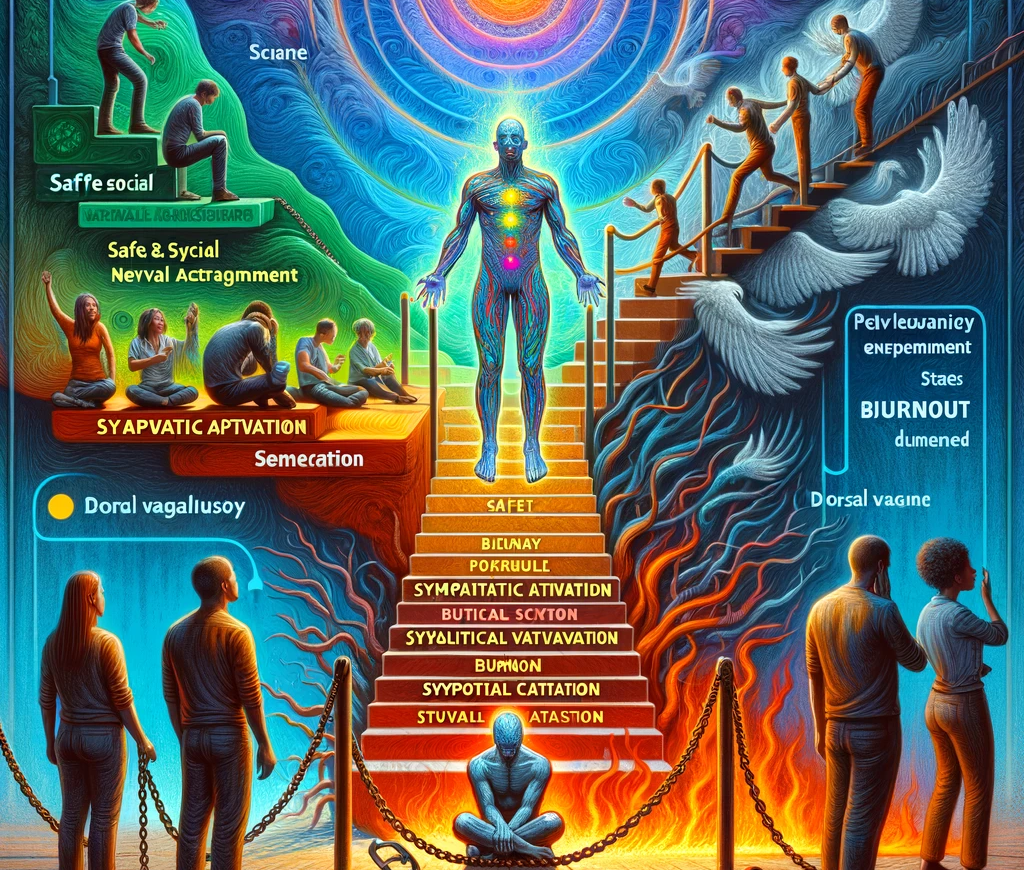
People-Pleasing, Burnout and Polyvagal Theory
People-Pleasing, Burnout and Polyvagal Theory
People-pleasing is more than a social habit: it is rooted in our biological need for connection and safety. For most of human history, acceptance by the group was essential for survival, and our nervous systems learned to seek safety in social bonds. Today the drive to meet others’ expectations and to conform can activate these ancient survival mechanisms, leading to a constant search for external validation and an inability to find peace without it. In our practice we recognized this search for approval in the body, in posture and in a gaze that keeps checking the other’s face, well before polyvagal theory was discussed outside research circles; the theory now helps us understand why the pattern is so persistent.
This behavior often comes from early life experiences and attachment patterns: our nervous system developed under the influence of our first relationships. Under uncertainty or social pressure we may move down the “polyvagal ladder”, from a state of social engagement and safety to one of sympathetic activation, with its fight-or-flight responses. This shift can feed an exhausting cycle of people-pleasing, in which the constant need for approval triggers stress responses and finally leads to burnout.
Here burnout is the endpoint of chronic sympathetic activation that finds no resolution. It leads to dorsal vagal shutdown, the oldest defensive response, in which the body slows down and withdraws: a state of disconnection, numbness and inability to engage meaningfully with the world. This state of hypoarousal (very low activation) is the body’s last resort to protect itself from continuing stress and demands, and it shows as emotional and physical exhaustion.
To move away from people-pleasing and towards healthier relationships, we need to understand and regulate the responses of our nervous system. Mindful awareness of bodily sensations, self-regulation practices and clear personal boundaries help us leave survival mode and reach a state of balance and self-compassion. In this way we can build relationships on mutual respect and genuine connection, instead of fear and obligation.
Approaches centered on nervous system regulation, such as Somatic Experiencing (a body-based method for releasing stress), EMDR (a method that uses eye movements to process difficult memories) and applications of polyvagal theory, offer valuable tools to anyone who wants to break the cycle of people-pleasing. They help the nervous system become more regulated, reduce stress and build a basic sense of safety that allows healthier, more authentic relationships. Reading people-pleasing through the nervous system gives each person the means to explore their early relational patterns and their nervous system activations, opening the way to lasting change and more fulfilling relationships.
Learn the method
Mesmeric Polyvagal Therapy is taught in the courses of Dr. Paret's School (ISI-CNV – Université Européenne): live seminars and online lessons, from the first-level Master to advanced training, with specific expertise in polyvagal hypnosis, trembling, completion of the response and ventral vagal stimulation. Request the programme and the next dates: our first contact is always a WhatsApp message, never a call.
→ Request information on the courses
→ Videos and international activity of Dr. Paret
→ marcoparet.com: the School of Dr. Paret
This site is available in: English · Italiano · Français · Русский · 中文
Research notes
A selection of peer-reviewed studies on polyvagal theory and vagal function that offer a scientific reading of the topics discussed in this article.
Oosterman M, Schuengel C (2007). Physiological effects of separation and reunion in relation to attachment and temperament in young children. Developmental Psychobiology, 49(2), 119-128. In children aged 3 to 6, separation from the parent, but not from a stranger, was accompanied by vagal withdrawal (lower RSA), highlighting the autonomic side of attachment and dependence on the caregiver. https://doi.org/10.1002/dev.20207
Borelli JL, Shai D, et al. (2019). Interpersonal physiological regulation during couple support interactions: examining the role of respiratory sinus arrhythmia and emotional support. Psychophysiology, 56(11), e13443. In 100 couples, caregivers whose RSA rose more during a support conversation provided more emotional support, and their partners showed smaller RSA increases; the links held only when caregivers reported lower attachment anxiety. https://doi.org/10.1111/psyp.13443
Balzarotti S, Biassoni F, et al. (2017). Cardiac vagal control as a marker of emotion regulation in healthy adults: a review. Biological Psychology, 130, 54-66. Reviewing 135 papers, the authors report that higher resting cardiac vagal control tends to accompany better down-regulation of negative affect and more flexible emotional responding, while noting conflicting results across methods. https://doi.org/10.1016/j.biopsycho.2017.10.008
Page updated
Google Sites
Report abuse
This site uses cookies from Google to deliver its services and to analyze traffic. Information about your use of this site is shared with Google. By using this site, you agree to its use of cookies.
Learn more
Got it