Embedded Files
Do psychological types have a neurological basis? And how can the principles of Polyvagal Theory improve the way we communicate? On this page we take the psychological types described by Jung and the types of the Enneagram, and read them through Polyvagal Theory. Knowing these elements is essential for communication that rests on solid neurological concepts.

Emotions and Non-Verbal Communication
Emotions and Non-Verbal Communication
When we discuss personality types, we start from a point we have developed over many years: the movements of the hands and the postures of the body. Many texts speak of "connecting with others", "dominant behaviour" or "isolation", but they stay abstract and do not describe the non-verbal communication that goes with them. Which gestures express connection? Which express isolation? The question matters because our primary mode of communication is non-verbal, and words take their meaning from it.
Our approach is original, yet it connects with the work of several authors. One is Virginia Satir, a family therapist who described typical postures within family dynamics. We link them to hand movements: accusatory (close to Satir's "Blamer"), conciliatory (close to her "Placater") and over-rational (close to her "Computer"). Bandler and Grinder, the pioneers of NLP, also considered these types in their analysis of attitudes and associated them with the sensory channels: visual, auditory and kinaesthetic respectively.
Although we refer to Satir, our focus is on the non-verbal level. Here we draw on Italian researchers such as Benemeglio, who worked exclusively on non-verbal aspects, while our own analysis operates on a different plane.
One finding stands out: in non-verbal communication we can identify three fundamental tendencies of communicative attitude, a thesis supported by several authors. These attitudes correspond to Polyvagal Theory and its neurology. Gestures of acceptance and connection, present from infancy, are linked to vagal activation, that is, to the calming branch of the vagus nerve that supports the social engagement system (Porges, 2007). Accepting gestures, such as an open posture, are essential for co-regulation, the process by which two nervous systems calm each other. The empirical work of Meaney and colleagues (Champagne, 2008; Meaney, 2001) is significant here: studying maternal behaviour in rats, and by extension in humans, they showed how early tactile contact shapes a person's stress-management systems and the ability to handle stress throughout life. Early tactile experience matters (Champagne, 2008; Meaney, 2001).
Self-touching behaviours, often seen in situations of isolation, appear in adults as scratching or "blocking", for example gripping a part of one's own body. Studies show that self-touch is a form of self-regulation (Landau et al., 2003; Toda & Fogel). Moszkowski and Stack (2007) found that infants touch themselves more when the mother is unavailable, with active, reactive and soothing touches; when the mother is available, they touch her and use more passive touches. Touch behaviour changes according to social availability.
Finally, aggressive gestures, such as pointing or grabbing abruptly, are clearly linked to defence or attack. In Polyvagal Theory they are associated with sympathetic activation, the state of mobilisation for fight or flight.
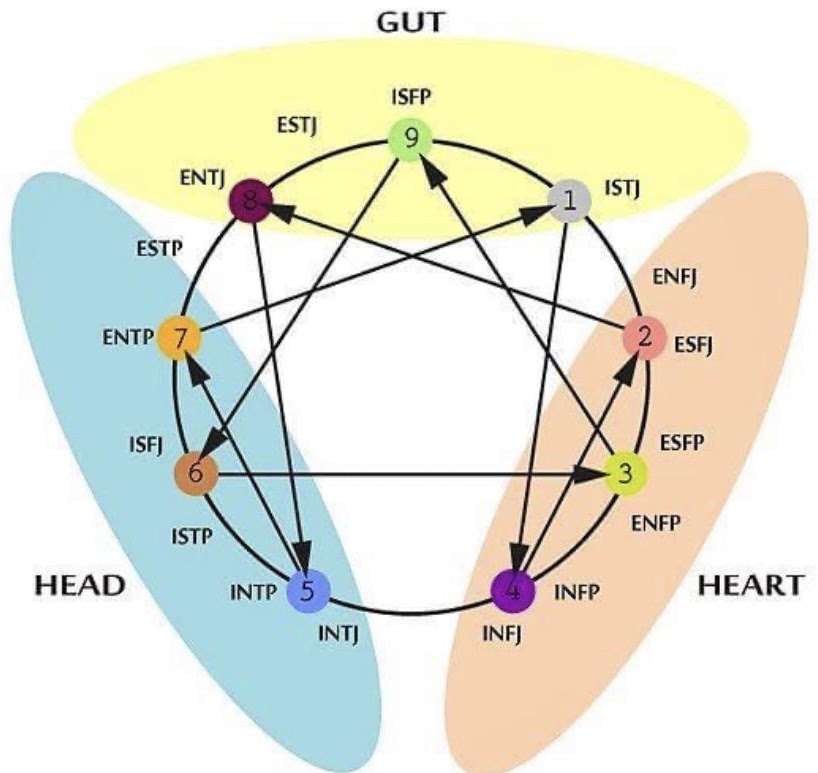
Polyvagal Theory Applied to Typologies
Polyvagal Theory Applied to Typologies
Enneagram Types, Jungian Archetypes and Polyvagal States
Enneagram Types, Jungian Archetypes and Polyvagal States
The Enneagram is a model of the human psyche made of nine interconnected personality types. It gives precise insight into our emotions and motivations. When we combine it with Jungian types and with Polyvagal Theory, we gain a deeper understanding of the person. Below we describe the nine Enneagram types, their Jungian counterparts as identified by statistical research, and how they relate to the states of our nervous system described by Polyvagal Theory.
Type 1: The Reformer and the ISTJ Type
Enneagram Type 1s, the Reformers, embody order and idealism. They correspond to the Jungian ISTJ type (Introverted, Sensing, Thinking, Judging), which gives priority to structure and duty. In Polyvagal terms, a healthy Type 1 shows a balanced ventral vagal state, the branch of the vagus nerve linked to calm and social engagement. Under stress they may shift into a high sympathetic state, with obsessive-compulsive tendencies. In this heightened arousal, their drive for perfection becomes relentless and often leads to rigidity (dorsal vagal activation, the branch linked to shutdown and immobility) and to a critical attitude.
Type 2: The Helper and the ENFJ/ESFJ Types
Type 2s, the Helpers, are caring and oriented to relationships. They correspond to the extraverted feeling types of Jung, ENFJ and ESFJ. They naturally show high ventral vagal activity, which supports deep connection and empathy. At their pathological extreme they may experience dysregulated sympathetic arousal, expressed as manipulative or histrionic behaviour. Their wish to be loved and appreciated can then turn into a fear of abandonment that leads them into unhealthy relationship patterns.
Type 3: The Achiever and the ESFP/ENFP Types
Type 3s, the Achievers, are oriented to success and share the adaptable, resourceful nature of the Jungian ESFP and ENFP types. They show a balanced sympathetic state, which drives them towards goals and efficiency. In a high sympathetic state their search for validation can become narcissistic or grandiose: fear of failure and the need for admiration take over from their authentic self.
Type 4: The Individualist and the INFP/INFJ Types
Type 4s, the Individualists, are introspective and often correspond to the reflective, idealistic Jungian types INFP and INFJ. They usually maintain a high ventral vagal state, which allows intense emotional experience and creative expression. Under significant stress they may sink into a low ventral vagal state associated with depression: their depth of feeling turns inwards and isolates them from the support they need.
Type 5: The Investigator and the INTP/ISTP Types
Type 5s, the Investigators, correspond to the analytical Jungian types INTP and ISTP. At their best they operate in a balanced ventral vagal state, which reflects their capacity for detachment and careful analysis. When overwhelmed they may withdraw into a high dorsal vagal state, typical of avoidant behaviour. This "freeze" response can lead to social withdrawal and a deeper sense of isolation.
Type 6: The Loyalist and the ISFJ/ISTP Types
Type 6s, the Loyalists, are the committed security-seekers of the Enneagram. They often correspond to the Jungian ISFJ and ISTP types, which combine introverted sensing with thinking or feeling. In balance, Type 6s show a high ventral vagal tone, which makes trust and cooperation possible. Under threat they may experience dysregulated sympathetic activation, with paranoid or excessively anxious behaviour. This shift reflects the Loyalist's conflict between seeking security and giving in to fear, often by imagining worst-case scenarios as a defence.
Type 7: The Enthusiast and the ENTP Type
Type 7s, the Enthusiasts, seek joy and correspond to the innovative, extraverted Jungian ENTP type. They thrive in a high ventral vagal state and meet life with optimism and curiosity. When trapped or in pain they may slide into a high sympathetic state with manic tendencies. This is the Enthusiast's attempt to escape discomfort through constant stimulation and novelty, often avoiding deeper emotional work.
Type 8: The Challenger and the ESTP/ENTJ Types
Type 8s, the Challengers, embody strength and assertiveness and correspond to the forceful, dynamic Jungian ESTP and ENTJ types. At their best they operate in a balanced sympathetic state and use their energy to protect and lead. When their control is threatened they may escalate into a high sympathetic state, with aggressive or confrontational behaviour. This reaction reveals the Challenger's deep vulnerability, hidden behind an appearance of invincibility.
Type 9: The Peacemaker and the ISFP Type
Finally, Type 9s, the Peacemakers, find their Jungian counterpart in the gentle, accommodating ISFP type. In harmony, Type 9s show high ventral vagal activation, which supports peace and understanding. In conflict, or when they neglect themselves, they may slip into a high dorsal vagal state, marked by passivity or dissociative tendencies (a sense of being detached from oneself). This response is the Peacemaker's retreat from tension: they reduce their own presence to keep the peace around them, at the expense of their own needs and wishes.
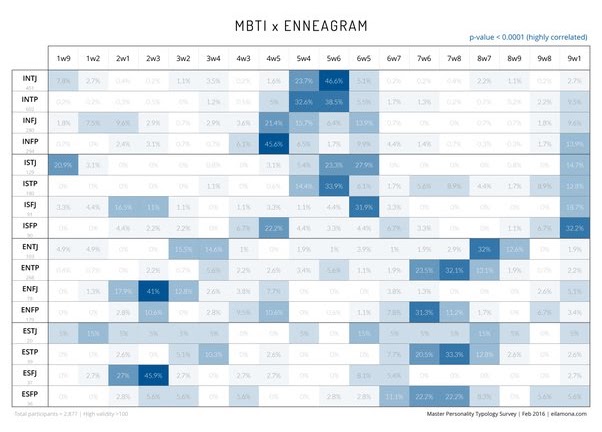
Correlations Between the Enneagram and MBTI
Correlations Between the Enneagram and MBTI
Below is the statistical basis used for the correlation between MBTI and the Enneagram.
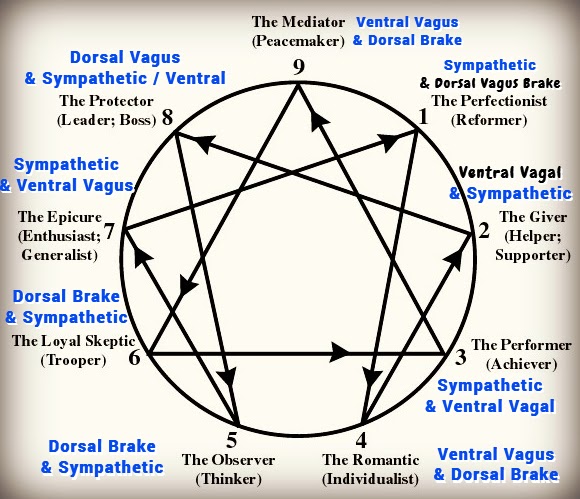
A Proposed Link Between the Enneagram and Polyvagal Theory
A Proposed Link Between the Enneagram and Polyvagal Theory
This is a tentative connection, which we explore further in the following pages.

Further Notes on NLP3, Communication and Polyvagal Theory
Further Notes on NLP3, Communication and Polyvagal Theory
NLP3 (Third Generation Neuro-Linguistic Programming) marks a significant step forward in the understanding of human communication and psychology. About twenty years ago I took part in introducing NLP to Italy. At the time NLP focused on the visual, auditory and kinaesthetic sensory channels. Through experience and practice, observing hundreds of people and integrating other approaches that also recognised three main channels, I saw the need to look deeper. This led me to the Enneagram, which I found could be integrated with NLP: this is how NLP3 was born.
NLP3 offers a broader and more detailed view of communication: it identifies a person's "communicative stance", not only the sensory channel. This is far more powerful, because it links communicative styles and behaviours to specific strategies and movements, such as those of the hands. I noticed that activity and movement were key indicators of the sensory types: "visuals" tended to be more active and oriented to action, "auditories" more reflective and detached, and "kinaesthetics" more socially oriented and connected to others.
These observations showed me that relying only on sensory channels was limiting, and so was NLP itself, because much more could be achieved. I came to recognise that a person's predominant channel can derive from an innate disposition: towards action (the indicative attitude, which turns into attack under stress), towards reflection (the super-logical attitude) or towards social connection (the propitiatory attitude). The sensory preference then appears as a derived element rather than the origin.
We had been observing these three patterns of gesture and posture in our practice for years before I encountered Polyvagal Theory. When I did, I saw that it explains them in a coherent way: each communicative style corresponds to a state of activation of the nervous system, attack (visuals), distance (auditories) and social connection (kinaesthetics). This multidimensional approach has greatly enriched our understanding of interpersonal dynamics and given us more effective tools for communication and therapy.
In short, integrating NLP3 with Polyvagal Theory gives rise to a new approach that we might call neurovagal communication. It represents a qualitative leap in the understanding of communication, because it brings sensory, behavioural and neurological aspects into one coherent framework that respects the diversity of human experience.

Virginia Satir, NLP3 and Polyvagal Theory
Virginia Satir, NLP3 and Polyvagal Theory
The path from Neuro-Linguistic Programming (NLP) to Polyvagal Theory, and then to NLP3, offers a new reading of sensory channels and of the communication and defence strategies of each person. NLP, rooted in communication techniques and processes of change, meets Polyvagal Theory at an interesting point: the work of Virginia Satir, known for her contribution to family therapy and a source of inspiration for the pioneers of NLP. NLP3 makes it possible to bring these approaches together.
Communication Strategies According to Virginia Satir and NLP
Communication Strategies According to Virginia Satir and NLP
Virginia Satir identified several communication styles within family dynamics, including:
The Blamer or Accuser: under stress this person becomes aggressive and tends to attack, asserting what they believe is right. In NLP this style was associated with the visual channel, because the person focuses on what they perceive as injustices or errors.
The Super-Reasonable: this person keeps a detached stance and takes refuge in logic as a defence. Their communication shows emotional distance and a cold analysis of facts.
The Placater: this person avoids conflict at all costs, agreeing with others and accepting their opinions to keep the harmony. This too is a defence mechanism.
Interpretation through Polyvagal Theory
Interpretation through Polyvagal Theory
Stephen Porges' Polyvagal Theory offers a framework for understanding these strategies as responses of the nervous system:
The Accuser may show a "blended state", in which sympathetic activation (readiness for action and fight) coexists with dorsal activation (stiffness, possible withdrawal). This combination produces aggressive, attacking behaviour.
The Placater may represent another "blended state", with co-activation of the ventral vagal system (which supports social connection and calm) and the dorsal system (which can bring some disconnection or submission). The result is conciliatory behaviour aimed at keeping the peace.
The Super-Reasonable may correspond to a predominantly dorsal activation, in which detachment and disconnection prevail. The result is cold, analytical behaviour, distant from emotional involvement.
These correlations between Satir's communication strategies and the concepts of Polyvagal Theory show how deeply our physiological states shape the way we interact. Understanding these dynamics allows us to develop more effective strategies for emotional regulation and communication, in therapeutic settings and in everyday life.
Using the Polyvagal Approach
Using the Polyvagal Approach
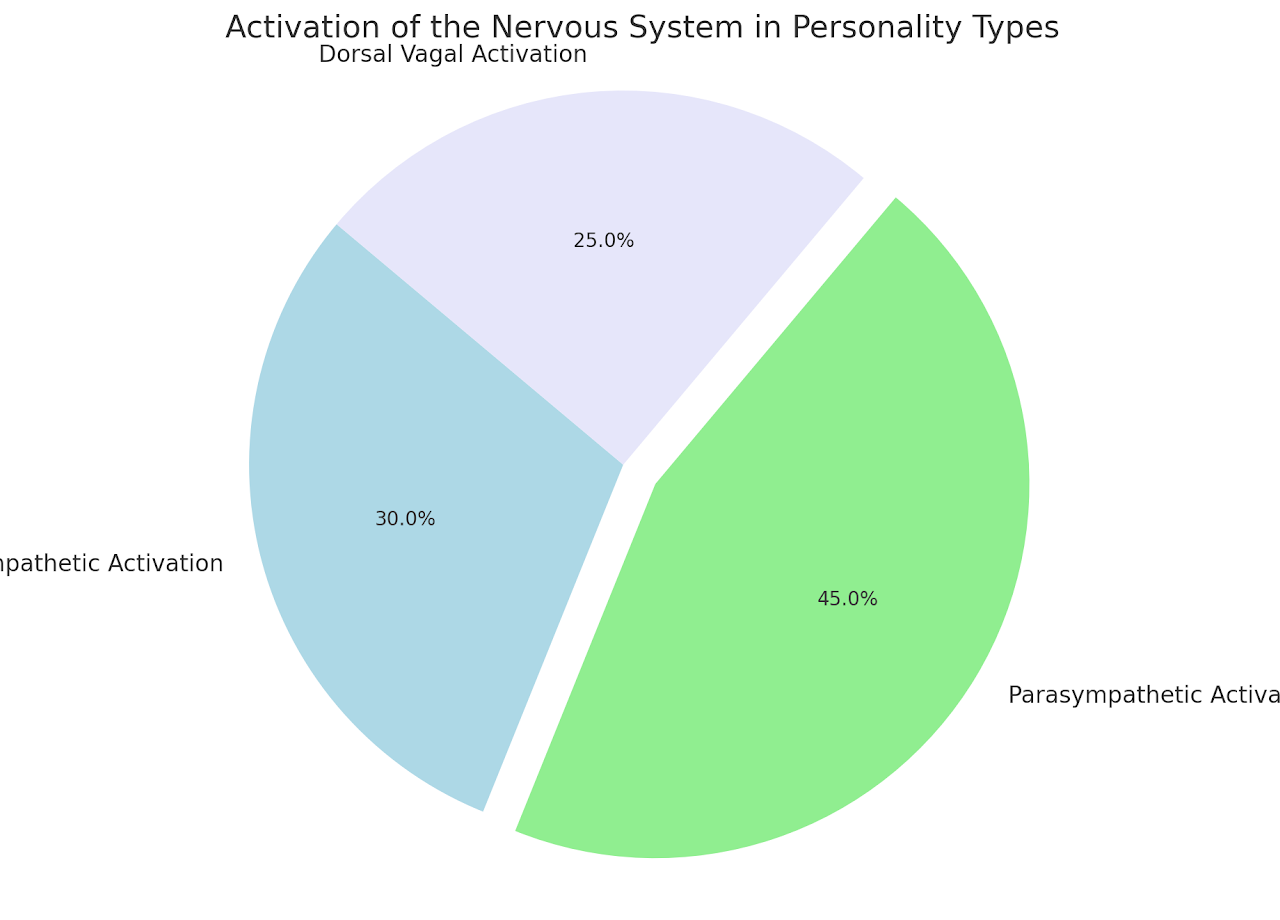
Polyvagal Theory gives us a framework for reading the neurology behind certain attitudes and behaviours. By examining the various personality types, we can understand the neurological basis of specific actions. Personality descriptions often say that some people are very active while others are more passive or receptive. We can translate this into activation of the sympathetic system and of the parasympathetic (vagal) system, including the dorsal vagal branch. This offers another lens on personality types, with one advantage: it does not derive from any particular system, so it can be used to interpret any system. It is as if we had found the lowest common denominator behind every number.
Learn the method
Mesmeric Polyvagal Therapy is taught in the courses of Dr. Paret's School (ISI-CNV – Université Européenne): live seminars and online lessons, from the first-level Master to advanced training, with specific expertise in polyvagal hypnosis, trembling, completion of the response and ventral vagal stimulation. Request the programme and the next dates: our first contact is always a WhatsApp message, never a call.
→ Request information on the courses
→ Videos and international activity of Dr. Paret
→ marcoparet.com: the School of Dr. Paret
This site is available in: English · Italiano · Français · Русский · 中文
Research notes
A selection of peer-reviewed studies on polyvagal theory and vagal function that offer a scientific reading of the topics discussed in this article.
Porges SW (2009). The polyvagal theory: new insights into adaptive reactions of the autonomic nervous system. Cleveland Clinic Journal of Medicine, 76(Suppl 2), S86-S90. A concise overview proposing that the face-heart connection of the mammalian vagus forms a social engagement system through which social interaction can influence visceral state; it offers a frame for reading behavioural styles as autonomic strategies. https://doi.org/10.3949/ccjm.76.s2.17
Thayer JF, Lane RD (2000). A model of neurovisceral integration in emotion regulation and dysregulation. Journal of Affective Disorders, 61(3), 201-216. The neurovisceral integration model links autonomic, attentional and affective systems and interprets excessive sympathetic activation as a failure of inhibitory control; it provides a physiological lens for stable patterns of emotional reactivity. https://doi.org/10.1016/s0165-0327(00)00338-4
Beauchaine TP (2015). Respiratory sinus arrhythmia: a transdiagnostic biomarker of emotion dysregulation and psychopathology. Current Opinion in Psychology, 3, 43-47. Beauchaine reviews evidence that low respiratory sinus arrhythmia and excessive vagal withdrawal under challenge are found across many forms of emotion dysregulation, including attention problems and hostility, and links them to prefrontal control. https://doi.org/10.1016/j.copsyc.2015.01.017
Balzarotti S, Biassoni F, et al. (2017). Cardiac vagal control as a marker of emotion regulation in healthy adults: a review. Biological Psychology, 130, 54-66. Reviewing 135 papers, the authors report that higher resting cardiac vagal control tends to accompany better down-regulation of negative affect and more flexible emotional responding, while noting conflicting results across methods. https://doi.org/10.1016/j.biopsycho.2017.10.008
Page updated
Google Sites
Report abuse
This site uses cookies from Google to deliver its services and to analyze traffic. Information about your use of this site is shared with Google. By using this site, you agree to its use of cookies.
Learn more
Got it